
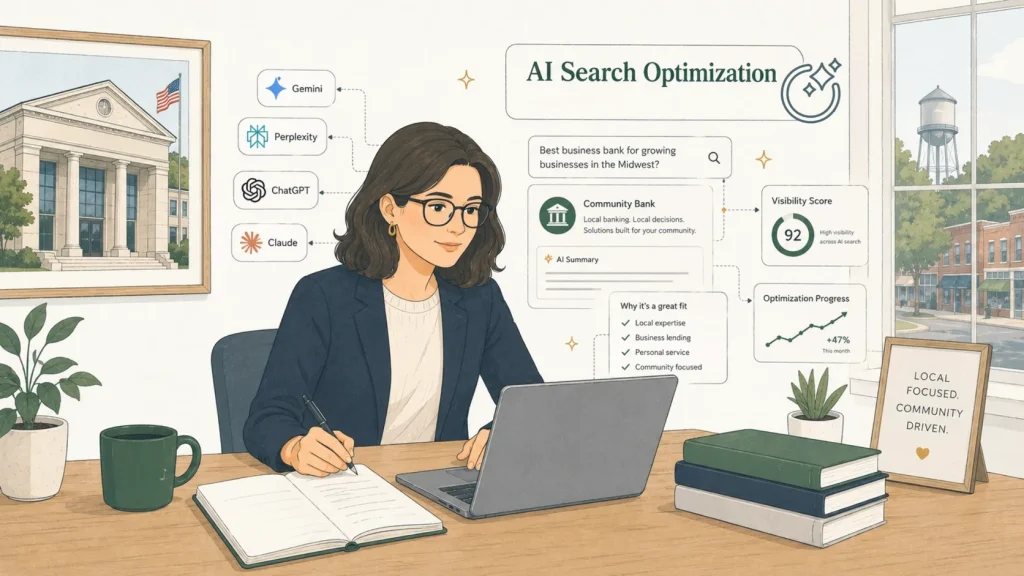
TL;DR
Answer engine optimization (AEO) and generative engine optimization (GEO) are the practice of structuring a bank’s web content so AI tools can find, trust, and cite it when people ask financial questions. It builds on traditional SEO and focuses on being retrievable inside AI answers from Google’s AI Overviews and AI Mode, ChatGPT, and Perplexity. For banks, GEO matters now because about half of U.S. adults already use AI chatbots, and many turn to them to compare accounts, loans, and providers before they ever reach a bank’s website.
Key takeaways
- AEO is now part of Search itself. Google names AI Overviews and AI Mode as core features and, since June 2026, reports impressions inside them in Search Console.
- Consumer adoption is mainstream. Pew found AI chatbot use among U.S. adults rose from 33% in 2024 to 49% in 2026, with adults under 50 most likely to use them to search for information.
- GEO connects directly to client acquisition. BCG places GEO and answer engine optimization inside the “Attract and Acquire” function for AI-first retail banks.
- The customer relationship is contested. J.D. Power reports that 20% of retail bank customers moved money away from their primary bank in a recent three-month period.
- GEO is a trust strategy. Expert-led, well-sourced, clearly disclosed content is what AI systems retrieve and what compliance teams can stand behind.
Search now happens inside the answer
Ask about a mortgage or a business account today, and the first thing many people see isn’t ten blue links. It’s a synthesized answer.
Google has been direct about this. Its guidance states that “optimizing for generative AI search is optimizing for the search experience,” and it names AI Overviews and AI Mode as features content has to account for. This is not SEO being replaced. Google is clear that foundational SEO still matters, because these features run on the same ranking and quality systems. The pages that earn AI citations are usually the ones already performing in classic search.
The clearest signal came in June 2026, when Google added reporting for impressions inside generative AI features to Search Console. Platforms measure what matters to them.
Consumers moved first. Pew Research Center found AI chatbot use among U.S. adults climbed from 33% in 2024 to 49% in 2026, and that about half of adults under 50 use chatbots to search for information. For a bank, that age band covers first mortgages, new checking relationships, small business accounts, and early wealth conversations.
Banking discovery is moving into AI-assisted journeys
Saying AI search is growing is one thing. Showing it reach financial services is another.
BCG’s 2026 work on AI-first retail banking is the most direct evidence. It places GEO and answer engine optimization (AEO) inside the “Attract and Acquire” function, tying them to better discovery and, in its reporting, a 40% increase in new-to-bank sales from this kind of acquisition capability. AI visibility maps to account openings, the kind of result that shows up in new-account and funded-loan numbers.
The traffic data agrees. Adobe Digital Insights reported that financial services AI visit share grew 158% year over year in early 2026, and that AI-referred visitors tend to be more engaged than other traffic.
And it’s reaching real decisions. EY’s 2026 survey of more than 18,000 people found that 49% had used AI to support savings and investment decisions, and 21% used AI agents for product recommendations. When someone asks an AI tool to compare HELOC options or explain how FDIC coverage works across accounts, the bank named in that answer starts a step ahead.
The customer relationship is up for grabs
Here is the part that should hold a bank’s attention.
McKinsey’s 2026 Global Banking Annual Review calls AI adoption “the fastest in history” and warns that banks face rising challenges to customer ownership, from fintechs and neobanks to agentic AI and digital assets. The competition isn’t only for new accounts. It’s for who shapes a customer’s understanding before a bank enters the conversation.
J.D. Power’s 2026 retail banking research makes that concrete. The average checking customer now keeps three deposit accounts across different institutions, and 20% moved money away from their primary bank in a recent three-month window, up from 17% a year earlier. J.D. Power calls this “soft switching,” quiet movement of money rather than a clean break.
PwC frames the upside, describing banks that use AI to personalize experiences, sharpen lead generation, and “reach the right customer with the right product at the right time.” The thread across all three: trust has to be earned earlier, at the moment a question gets asked.
What answer engine optimization (GEO) means for a bank
GEO has a hype problem. There’s no shortage of advice promising that one technical trick wins AI search. Most of it ignores how banking works.
Google’s own guidance pushes back, steering toward unique, valuable, people-first content and away from GEO hacks. For a regulated institution, that’s good news. It rewards what strong banks already have: real expertise, defined products, and an obligation to be accurate.
In practice, GEO for a bank means publishing content that answers the questions customers actually ask an AI tool, structured so the answer is easy to retrieve and safe to cite. Pages like how FDIC insurance applies across account types, what a first-time homebuyer should weigh before choosing a lender, or which financial covenants, like a minimum debt-service-coverage ratio, a regional bank typically expects on a $5M commercial term loan. Specific, current, and built on real sources. It’s the same discipline behind a strong local SEO strategy for banks, extended into AI-mediated search. None of this displaces local SEO. For most banks, ranking in the map pack and local results is still one of the most direct ways to turn nearby, high-intent searches into branch visits, calls, and applications, and GEO works alongside it, not in place of it.
Compliance belongs in the design. An AI system can pull product terms, rates, and eligibility language out of context. Content built with accurate disclosures, correct APY and APR references, and the thinking behind UDAAP, Truth in Savings (Regulation DD), and FDIC advertising rules already in view is content where the retrievable version is also the compliant version. (This is general information, not legal advice. Your compliance team should review anything published.)
A GEO content checklist for banks
- Named expert authorship with real credentials
- Clear publication and last-updated dates
- Disclosures and required advertising language in place
- Primary-source citations, including your own rate sheets
- Headings that mirror how customers phrase questions
- Product eligibility and qualification details
- Service-area and local specificity
- A genuine FAQ section, not filler
- Clear next steps for the reader
- Schema markup where it helps, without obsessing over it
Frequently asked questions
What is generative engine optimization (GEO) for banks?
GEO is the practice of structuring a bank’s content so AI search features and chatbots can find, understand, and cite it when people ask financial questions. It builds on SEO and focuses on being retrievable and quotable inside AI answers like Google’s AI Overviews and AI Mode, ChatGPT, and Perplexity, not only ranking in a list of links.
How is GEO different from SEO for banks?
SEO ranks your pages in a list of links. GEO makes your content the source an AI system pulls from when it writes an answer. They aren’t rivals. Google has said the foundations overlap, since AI features run on the same ranking and quality systems. Strong SEO, including local SEO, is the base, and GEO adds structure, clarity, and citable expertise on top.
Does GEO replace SEO for banks?
No. SEO and GEO solve different parts of the same problem, and banks need both. Local SEO is still one of the most reliable ways to win nearby, high-intent searches and turn them into branch visits, calls, and applications. GEO extends that visibility into AI answers. Google itself says generative AI features run on the same ranking and quality systems, so strong SEO is what makes GEO work, not a thing GEO leaves behind.
Does AI search actually affect how customers choose a bank?
Increasingly, yes. EY’s 2026 survey found that 49% of global consumers had used AI for savings and investment decisions, and BCG ties GEO and AEO to new-to-bank sales for AI-first retail banks. Customers form impressions inside AI answers before they reach a bank’s site, which makes early visibility a competitive factor.
Will AI Overviews reduce traffic to a bank’s website?
It can change the shape of traffic. Some informational clicks may fall, but visits that arrive from AI experiences tend to be higher-intent. The goal is to be the cited, trusted source inside those answers, so your bank stays in the consideration set even when click counts look different.
How can a bank measure AI search visibility?
As of June 2026, Google’s Search Console reports impressions inside generative AI features such as AI Overviews and AI Mode. That gives banks a first-party way to see where their content appears in AI search. Pairing it with lead and account-opening data shows whether that visibility is connecting to business.
AI search is becoming the first place a prospective customer forms a view about where to bank. The institutions that show up as the clear, credible answer won’t get there with hacks. They’ll get there with expert content built to be found, trusted, and cited, the same standard that earns trust with a sophisticated buyer in any channel. If you’re weighing how AI search fits your acquisition strategy, our Answer Engine Optimization service for financial firms is built for banks that have to clear compliance and still get found.