

SEO for Banks: Unlock the Power of Local Search

How Regional and Community Banks Can Leverage Local SEO to Gain Marketshare

TL;DR

Regional and community banks can compete with national banks and fintech disruptors by combining local SEO with Answer Engine Optimization. Three foundational tactics, fully optimized Google Business Profiles for every branch, unique location-specific landing pages, and proactive review management, consistently drive higher visibility in map results, AI overviews, and geo-specific searches, translating into more foot traffic, account openings, and commercial loan activity.

Key takeaways: SEO for banks in 2025

  • Regional and community banks face rising competition from national giants and fintech disruptors.
  • Local SEO and Answer Engine Optimization help banks win location-specific searches and AI-powered search results, leading to an increase in foot traffic, account openings, and commercial loan activity.
  • This article highlights 3 tips to enhance local SEO for banks.
  • Download the full SEO for Banks Guide to get:
    • 8 advanced SEO tactics
    • 6 Google Ads strategies for high-intent leads
    • Answer Engine Optimization and Technical SEO tips to future-proof your bank’s digital marketing strategy

Regional and community banks are navigating unprecedented competitive pressure on two fronts:

  • National banking giants deploying billion-dollar marketing budgets
  • Nimble fintech challengers capturing the loyalty of digital-native customers

Consider this: in 2024, JPMorgan Chase alone spent $4.88 billion[i] on marketing. Deloitte’s Digital Banking Maturity[ii] study shows nearly every large institution is racing to upgrade mobile and online experiences. KPMG’s 2025 survey confirms this trend, with 95% of banks increasing investment in digital platforms and 91% funding data-driven personalization[iii] to deepen customer relationships.

For marketing leaders, competing in a digital-first world is no longer optional, it’s one of the key foundations for growth. The good news? Your institutions hold an inherent advantage.

Unlike national players chasing broad audiences, your banks are uniquely positioned to win locally. With deep community ties and reputations for personalized service, you can leverage local SEO, hyper-targeted Google Ads, and Answer Engine Optimization to capture high-intent, geographically relevant prospects, at a fraction of the cost of national campaigns.

This article outlines proven strategies to help you thrive in today’s hyper competitive, AI-driven, digital-first environment.

But first….

What is SEO and Answer Engine Optimization? And why does it matter for you?

Search Engine Optimization (SEO) enhances your digital presence, so potential clients find your institution during online searches. Local SEO, for banks, enables you to secure visibility in:

  • “Near me” searches
  • Google Maps results
  • Geo-specific queries like “business banking in Springfield”

Unlike national banks vying for ultra-competitive terms like “checking account”, you can dominate location-specific searches such as “home loans near downtown Portland” or “business banking Oak Park.”

Answer Engine Optimization, also called generative engine optimization (GEO), refers to the practice of tailoring your digital content and strategy to perform well within AI-driven search experiences, like Google’s AI Overviews, ChatGPT, Perplexity, and Gemini.

It is becoming increasingly more important. Users are doing more research via Large Language Models (LLMs) leading to lower click through rates from google searches, but they have much higher intent. Visitors from AI-enhanced search engine results, scroll deeper, stay longer, and convert better. This doesn’t mean that SEO is dead, quite the contrary, leveraging optimal SEO foundations will translate to greater visibility for AI tools.

Ranking higher means your institution captures more high-intent prospects at key decision moments, translating into increased brand trust, stronger engagement, and measurable growth.

If you haven’t already optimized your website and marketing for AI search tools you run the risk of falling behind rapidly.

Local SEO for banks: 3 tips to enhance local search visibility

1. Optimize your Google Business Profiles

Mobile phone displaying

Why it matters

Your Google Business Profile is the single most important piece of real estate in local search and Google Maps. For many prospective customers, it’s the first thing they see when they search for your bank or a financial product in their area. If it’s incomplete, outdated, or inconsistent, you’re leaving room for competitors to take your place in the map results and in the customer’s mind. Optimizing your GBP is one of the key steps to ensure you show up first in Google’s Map Pack, reaching high intent targets when they need your service the most.

Action steps

  • Claim and verify each branch profile so you have full control over how your bank appears in Google Search and Maps.
  • Fill out every available field; from branch hours and services to categories and accessibility features, using language that’s accurate, compliant, and customer friendly.
  • Refresh your photos regularly with high-quality images of your branch exterior, interior, and team to keep your profile active and appealing.
  • Post updates on Google about rate specials, community events, or educational content, ensuring each post passes compliance review.
  • Add structured data (schema) to your branch web pages so Google and AI search tools like ChatGPT or Gemini can easily match your website to your profile.
  • Track profile activity – calls, clicks, and direction requests, to measure how GBP is driving customer engagement.

Example

A multi-branch Midwest bank builds a consistent GBP presence across all locations, adds fresh images every quarter, and posts compliance-approved updates weekly. Over time, the bank begins consistently appearing in the top three map results for its priority local searches.

Common pitfalls

  • Inconsistent name, address, and phone details across directories.
  • Keyword stuffing the business name, which can result in penalties.
  • Forgetting to update hours for holidays or unexpected closures.
  • Not answering customer questions posted in the GBP Q&A section.

2. Create location-specific landing pages
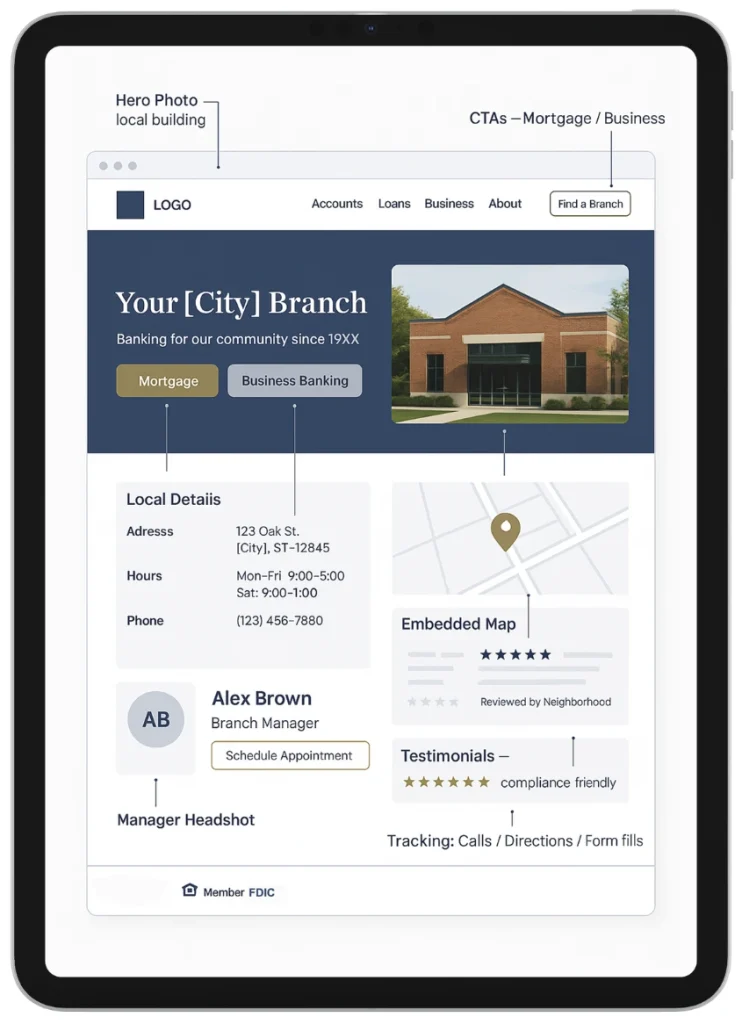
Location-specific bank branch webpage on tablet showing local details, map, manager profile, testimonials, and CTAs. Illustrating SEO for banks and local SEO for banks.

Why it matters

When someone searches for “mortgage lender near me” or “business banking in [City],” Google is more likely to show a page that’s clearly relevant to that location. A dedicated page for each branch tells both customers and search engines that your bank is active and invested in that community. Making it easier to rank higher and convert local traffic into real business.

Action steps

  • Create a dedicated page for each branch with unique information. Not just a copy-paste from other locations.
  • Include local details like branch manager bios, photos of the team, and community involvement highlights.
  • Embed a Google Map so customers can easily find you and Google can confirm your location.
  • Feature branch-specific testimonials that have been cleared through compliance, providing social proof from local customers.
  • Link directly to key products relevant in that market (e.g., mortgages in growing suburbs, business banking in commercial districts).
  • Ensure mobile friendliness so the page loads quickly and is easy to navigate on a phone.
  • Set up tracking to measure calls, form fills, and appointments coming from each page.

Example

A New England community bank builds unique pages for each of its 14 branches, highlighting local staff, photos, and community programs. These pages become highly visible in local searches and begin driving more inquiries from customers in each branch’s immediate area.

Common pitfalls

  • Reusing the same generic copy across all branch pages.
  • Not optimizing the page for mobile devices.
  • Hiding the page deep on the website instead of linking it from the main navigation.

3. Manage reviews proactively

Bank website reviews module with 5-star, verified customer testimonials. Demonstrating how proactive review management strengthens SEO for banks and local SEO for banks.

Why it matters

Online reviews are now a major trust signal for both customers and search engines. In banking, where decisions carry high financial stakes, a strong, well-managed review profile can make the difference between being considered or overlooked. Reviews also directly influence where your bank appears in local search results, influencing whether customers choose you over a competitor.

Action steps

  • Implement an automated process for requesting reviews after key customer interactions, such as loan closings or account openings.
  • Respond to every review, positive or negative, within 48 hours, following a compliance-approved script.
  • Track and analyze review sentiment over time to identify patterns that may indicate operational issues or strengths.
  • Highlight positive reviews (with customer permission) on your website, social media, or marketing materials.
  • Coordinate with compliance to ensure all responses avoid unverified claims or prohibited language.

Example

A Southeastern regional bank sets up an automated post-service review request system and develops approved response protocols. Within months, its average Google rating improves, and search visibility increases for competitive local queries.

Common pitfalls

  • Only requesting reviews from select customers, which may raise compliance concerns.
  • Posting fake or incentivized reviews, risking public trust and penalties.
  • Ignoring recurring themes in negative reviews, allowing problems to persist.

These are a few strategies that will get you on your way to optimizing your online footprint. For an extensive guide.

Download SEO for Banks: Unlock the Power of Local Search” and get:

– 5 additional advanced SEO tactics
– 6 Google Ads strategies for high-intent leads
– Answer Engine Optimization and Technical SEO tips to future-proof your bank’s marketing

Let’s make your bank the obvious choice.

We specialize in SEO services for banks. Turn nearby searches into calls, visits, and applications.

Finpact partners with regional and community banks, credit unions, and financial firms on strategy, design, build, and ongoing management. Serious infrastructure for serious firms.

Frequently asked questions

What is SEO for Banks?

SEO for Banks is the process of improving your bank’s digital presence so prospective customers can find you in search engines at key decision moments. It includes on-page optimization, technical SEO, content strategy, and authority building, tailored to regulated financial products and multi-branch realities.

What is local SEO for banks, and how is it different?

Local SEO for banks focuses on location-based visibility. Think Google Maps, near me searches, and geo-specific queries. It prioritizes branch-level accuracy, Google Business Profiles, localized content, and reviews so each branch is discoverable to nearby customers with high intent.

Why does Answer Engine Optimization matter for banks?

AI search experiences increasingly shape how people research banks. AI Search Optimization ensures your content is structured, trustworthy, and easy for AI systems to reference so your institution shows up when prospects ask nuanced, intent-rich questions about accounts, mortgages, or business banking.

How long does it take to see results from SEO for banks?

Typical timelines are 3 to 6 months for meaningful traction, depending on your starting point, competition, and resourcing. Local signals often move first; broader organic growth compounds with consistent content, technical fixes, and authority building.

Which SEO elements should banks prioritize first?

Google Business Profiles for every branch, location-specific landing pages with unique content per branch, and review management with compliance-approved requests and responses. These three foundations usually deliver the fastest local lift.

Do banks need a separate page for each branch?

Yes. A dedicated, unique page per branch clarifies relevance for city and neighborhood queries and converts better. Include manager bios, local photos, embedded maps, accessible hours, offered services, and branch-specific CTAs. Avoid copy-pasting the same content across locations.

How do Google Business Profiles impact bank rankings?

Complete, consistent GBPs are critical for Map Pack visibility. Accuracy, fresh photos, timely posts, Q&A responses, and steady review activity all reinforce local relevance and trust. Keep holiday hours updated and monitor insights.

How should banks handle reviews while staying compliant?

Use a compliance-approved process to request reviews after key interactions and respond to all reviews, positive and negative, without discussing account specifics or making unverified claims. Never post fake or incentivized reviews. Track themes to inform service improvements.

How do banks measure ROI from SEO?

Tie KPIs to business outcomes across visibility, conversion, and quality: impressions, Map Pack rankings, GBP actions, organic traffic, tracked calls, appointments, form fills, account openings, funded loans, landing-page conversion rates, review sentiment, and assisted conversions.

How does SEO compare with PPC for banks?

SEO builds durable, compounding visibility; PPC captures demand immediately. Most banks do best with a hybrid plan: invest in SEO foundations for sustainable growth and use paid media to fill gaps, test messaging, and accelerate high-intent campaigns.

What technical SEO factors matter most for banks?

Mobile experience and site speed, structured data, crawlability and indexation, accessibility (ADA/WCAG) and clear disclosures, and security (HTTPS and privacy statements).

How should multi-state banks manage NAP and listings at scale?

Centralize your location data, sync it to major directories, and assign governance for updates. Standardize naming conventions and categories, and audit regularly to prevent drift. Automate where possible, but keep human QA for compliance and accuracy.

Can SEO support commercial and small-business banking?

Absolutely. Create targeted pages and resources for business segments, highlight relevant services, and publish localized case studies and FAQs that speak to their workflows and timelines.

What’s the best way to get started with SEO for banks?

Audit your current visibility, fix the fundamentals (GBPs, branch pages, reviews), and stand up a measurement framework tied to appointments, calls, and applications. From there, expand into consistent content publishing, technical enhancements, and AI Search Optimization.


Lead Generation For Financial Advisors: 6 Digital Tactics That Work

TL;DR

Financial advisors generate high-quality leads most effectively through a combination of six compliant, trust-focused digital strategies: a conversion-optimized website, SEO targeting high-intent keywords, targeted PPC advertising, educational webinars and videos, segmented email marketing, and social media campaigns focused on LinkedIn. The strongest results come from prioritizing qualified engagement and compliance over volume or vanity metrics.

Summary

  • Outlines 6 proven lead generation strategies tailored for financial advisors
  • Covers website optimization, SEO, PPC ads, webinars, email marketing, and social media
  • Emphasizes compliant, high-trust digital tactics to attract and convert qualified prospects
  • Offers actionable guidance to boost visibility, engagement, and client acquisition online
  • Designed for advisors seeking scalable growth in today’s competitive financial landscape

Generating high-quality leads for your advisory practice can be a challenge in today’s competitive financial services landscape. To stand out, you need a clear, strategic approach founded on precision and trust.

Leveraging digital resources not only enables you to connect with your target clients effectively, but also helps strengthen relationships and build trust, turning qualified leads into loyal, high-value clients. Below, we outline six strategies that financial advisors can implement to refine their lead generation efforts while staying true to the industry’s unique demands.

01. Build a website that drives engagement

Your website serves as both the gateway to your practice and the foundation of your digital presence. It’s not just a hub for information; it’s a major driver of lead conversion.

Design your site to guide visitors toward clear actions such as booking a consultation, subscribing to an email list, or downloading valuable resources like guides or whitepapers. Strong calls-to-action (CTAs) should be prominent and easy to engage with across all pages.

Given how much traffic originates from mobile devices, your site must be mobile-friendly and fast-loading.

To establish trust, include compliance-approved thought leadership and opinion pieces on timely topics.

A well-designed, user-centric website is an essential tool for attracting and converting qualified leads. It also screams professionalism, cultivating brand trust and credibility.

02. Use SEO to connect with high-intent clients

Search Engine Optimization (SEO) is a fundamental tactic for gaining visibility among your ideal clientele. Target high-value, intent-driven keywords like “Fee-only financial advisor” or “Best retirement planning strategies” to rank higher on search engine results pages.

Develop content that directly addresses the needs of clients, such as blog posts explaining complex topics or FAQs about common financial concerns. Ensure all content aligns with compliance standards while adding value to readers. The dual benefit? Your practice becomes more discoverable, and you position yourself as an industry authority.

03. Employ targeted PPC advertising

With Pay-Per-Click (PPC) campaigns, you can reach an audience that matches your ideal client profile in an efficient, measurable way. Platforms like Google Ads allow for precise targeting based on geographic location, demographics, or even search intent.

Craft ad copy that is both compliant and action-driven, linking prospects directly to landing pages optimized for conversion. These pages should include focused CTAs, like scheduling a call, making it easy for prospects to take the next step. A well-executed PPC campaign can yield significant returns by focusing your ad spend on channels and audiences most likely to convert.

04. Showcase expertise through webinars and videos

Educational content, such as webinars and videos, provides a platform for financial advisors to demonstrate their expertise while engaging with potential clients. Host sessions on critical topics like retirement strategies, tax-efficient investing, or market commentaries to address your audience’s concerns.

To ensure compliance, prepare all materials in advance and stay within regulatory guidelines. Post-webinar follow-ups are crucial for converting attendees into prospects. Short, actionable video content can also amplify visibility across platforms, especially when paired with strong CTAs like “Schedule a One-on-One Consultation.”

05. Capitalize on email marketing to nurture leads

Email marketing remains one of the most effective tools for financial advisors to maintain client relationships and nurture leads. A segmented email strategy allows you to send tailored messages that align perfectly with the recipient’s needs, such as personalized financial tips for new prospects or portfolio updates for existing clients.

Each email should provide clear value, whether it’s an article, a link to RSVP for an upcoming webinar, or an invitation to schedule a personal consultation. Include user-friendly links that prompt direct interaction, making it easy for recipients to engage and take action.

06. Implement social media campaigns

Social media platforms, especially LinkedIn, are pivotal for building your network and increasing visibility. Share insightful content, like retirement strategies or market trends, to educate your audience and position yourself as a trusted expert.

Join relevant industry groups to spark meaningful conversations or share updates on major financial trends.

LinkedIn advertising, in particular, offers exceptional targeting capabilities, ensuring your posts reach potential clients primed to benefit from your services.

Always prioritize compliance by regularly reviewing posts and comments to prevent unintended regulatory risks.

Strategizing for long-term success

Lead generation for financial advisors can be challenging, implementing these strategies transforms your online footprint into a powerful tool to attract and engage qualified leads. For financial advisors, this means more than just increasing visibility; it’s about building a trusted brand that resonates with your ideal clients. By leveraging tools like SEO, targeted PPC campaigns, and actionable content, you can connect with high-value prospects and position your firm as a leader in your space.

Every step you take toward optimizing your digital marketing strategy unlocks new opportunities for growth. From attracting quality leads and boosting engagement to distinguishing yourself in a competitive market, these methods lay the groundwork for enduring success.

Finpact partners with financial advisors, investment firms, banks, and insurers on strategy, design, build, and ongoing management. Serious infrastructure for serious firms.

Frequently asked questions

What are the most effective digital strategies for financial advisor lead generation?

The most effective strategies include building a conversion-optimized website, using SEO to rank for high-intent keywords, running targeted PPC campaigns, hosting webinars and videos to demonstrate expertise, nurturing leads through email marketing, and maintaining a strong presence on platforms like LinkedIn. Each tactic builds credibility and trust with potential clients.

Why is having a strong website important for financial advisors?

Your website is often the first impression prospects get. It should be designed to convert, offering clear CTAs like consultation scheduling or resource downloads. Mobile optimization, fast loading, and compliance-approved content such as thought leadership pieces are critical to attracting and converting leads.

How can SEO help me connect with qualified clients?

SEO allows your firm to appear when prospects search for services you offer (e.g., fee-only retirement planner). By optimizing for specific, intent-rich keywords and publishing valuable, compliant content, you improve your visibility and authority, leading to higher-quality inbound leads.

Are PPC ads worth the investment for smaller firms or solo advisors?

Yes, if done correctly. PPC (Pay-Per-Click) allows precise targeting by location, income, and search behavior. Even modest budgets can generate returns when linked to strong landing pages. It’s especially effective for boosting visibility during key moments like tax season or market volatility.

What types of content work best for financial webinars and videos?

Content that addresses pressing financial concerns, like retirement planning, tax-efficient strategies, or market outlooks performs best. Keep sessions informative, actionable, and compliant. Follow up after webinars to convert attendees into appointments or subscribers.

How can I use email marketing to nurture leads without being intrusive?

Send value-packed emails tailored to each segment. E.g., market updates for current clients and what to expect from a financial plan for prospects. Include useful links (webinars, consultations, guides) and make interaction easy through user-friendly CTAs.

What role does AI play in digital lead generation today?

AI tools, like Google’s AI Overviews or ChatGPT, are changing how people search and discover content. To stay competitive, advisors should structure their content for AIO inclusion: use clear headlines, bulleted FAQs, schema markup, and answer-first formats. This improves visibility even if users don’t click through.

How do I ensure my digital marketing efforts remain compliant?

Work with professionals familiar with SEC, FINRA, and CSA/CIRO guidelines. Always pre-approve content, avoid performance promises, and use disclosures when necessary. Tools like compliance workflows or advisor-specific marketing platforms can help manage risk.

Digital Marketing for Investment Firms: A Data-Driven Approach

TL;DR

Digital marketing measurably improves investment firm performance, and the benefit is disproportionately large for smaller firms. A 2023 peer-reviewed study found that marketing capability accounts for over 73% of digital marketing’s impact on firm performance, and that boutique asset managers can outcompete legacy incumbents through clear strategy and operational discipline, not larger budgets.

Key takeaways

  • Digital marketing positively correlates with firm performance. Statistically significant, directionally unambiguous.
  • Marketing capability mediates 73%+ of the impact. Capability, not budget or visibility alone, is the catalyst.
  • Smaller firms see disproportionate benefits. Digital equalizes visibility and rewards operational discipline.
  • Digital marketing is operational infrastructure. It aligns marketing, sales, compliance, and CRM, not just brand output.
  • Integrated data outperforms. Firms that integrate marketing data across operations are 3x more likely to outperform on acquisition and retention.

In today’s capital markets, performance alone is no longer the sole benchmark of an investment firm’s success. Increasingly, firms are being evaluated on the clarity, consistency, and credibility of their communication, critical components of brand equity in an environment shaped by information asymmetry, regulatory oversight, and elevated investor expectations. This is where digital marketing for investment firms can really add value and enhance firm performance.

A 2023 peer-reviewed study published in Sustainability (2023)1 provides compelling empirical evidence: firms that adopt digital marketing capabilities see measurable gains in performance through enhanced sales and operational synergies. While this relationship is often acknowledged anecdotally, the study quantifies digital marketing’s strategic impact, and offers a data-driven framework for investment firms seeking to strengthen distribution, brand equity, and investor engagement.

The study: quantifying digital marketing’s impact

Researchers examined 200 top-performing publicly listed companies in South Korea, a digitally mature and competitive market that includes both large-cap incumbents and agile high-growth firms.

Key research questions included:

  • Does digital marketing improve firm performance?
  • Is this impact mediated by a firm’s marketing capability?
  • Does firm size affect the magnitude of the benefit?

Three core variables were analyzed:

  • Digital Marketing Innovation (DMI): Proxied through engagement metrics on Facebook and YouTube. While consumer-facing, these metrics serve as indicators of digital fluency and stakeholder interaction.
  • Marketing Capability (MC): Measured via stochastic frontier analysis, capturing a firm’s efficiency in converting marketing inputs (SG&A, assets, patents) into revenue.
  • Firm Performance (FP): Assessed using Tobin’s Q, a valuation metric reflecting the market’s perception of future potential and competitive positioning.

Findings: capability as the catalyst

The study’s results were both statistically significant and directionally unambiguous:

  1. Digital marketing correlates positively with firm performance.
  2. Marketing capability is the key mediator, accounting for over 73% of the total performance impact.
  3. Smaller firms derive outsized benefits relative to their larger peers.

The findings reinforce a fundamental principle: digital marketing is most effective when embedded within a firm’s broader operating architecture. Unlike traditional channels, digital strategies yield granular, actionable data that can be tightly integrated across marketing, sales, and operations.

Consider a typical interaction: an investor lands on a fund page, submits an inquiry, and is entered into a CRM workflow. Sales receives an alert, compliance logs the interaction, and marketing initiates tailored follow-up. The result isn’t just lead generation; it’s infrastructure that supports lifecycle engagement, investor retention, and scalable distribution.

What this means for investment firms

1. Performance isn’t just alpha

Investors increasingly evaluate firms on intangibles: perceived credibility, operational effectiveness, and quality of communication. Tobin’s Q, in this context, becomes a proxy for brand strength, and future earnings potential, not just AUM and Revenue.

2. Digital marketing as operational infrastructure

Digital marketing capability is not just about aesthetic output; it’s also about operational precision. For investment managers, this means:

  • Deploying SEO and content to educate segmented audiences.
  • Structuring CRM automations to nurture investor relationships compliantly.
  • Using analytics to refine messaging by segment (e.g., institutional vs. retail).
  • Managing fund launches, webinars, or market commentary with controlled workflows.

According to Deloitte2, firms that integrate marketing data into sales and operations are 3x more likely to outperform on customer acquisition and retention. It’s not just decoration; it’s data that aligns internal operations around a shared infrastructure framework.

Why smaller firms stand to gain the most

One of the study’s most insightful findings: smaller and mid-sized firms see disproportionate benefits from digital marketing innovation.

Why?

  • Digital Equalizes Visibility: A boutique asset manager with a well-executed digital presence can outrank incumbents in search, outperform on engagement, and lead discourse in industry verticals. Visibility is no longer gated by headcount or legacy brand.
  • Higher ROI per Dollar Spent: For mid-sized RIAs or PE firms, digital tactics such as high-intent SEO, segmented email marketing, and targeted paid search offer more trackable, efficient investor touchpoints than legacy tactics like print ads or conference booths.
  • Competency as a Brand Signal: In a saturated content landscape, how a firm communicates is a signal. An elegant website, consistent thought leadership, and thoughtful timely social engagement are not just tactics; they reflect strategic alignment, operational maturity, and client-centric thinking.

For these firms, digital marketing is not just a revenue generator; it’s a signal of sophistication.

Closing insight

The most successful investment firms won’t be those with the largest marketing budgets, but those with the clearest strategies. Digital marketing for investment firms, provides a creative, cost-effective way to engage investors and enhance firm performance.

The question isn’t whether to invest in digital, it’s how deliberate and intelligent that investment is made?

If you’d like to discuss your firm’s digital marketing strategy further let’s connect.

Finpact partners with investment firms, advisors, banks, and insurers on strategy, design, build, and ongoing management. Serious infrastructure for serious firms.

Frequently asked questions

How does digital marketing improve investment firm performance?

Digital marketing improves investment firm performance by strengthening investor engagement, distribution, and brand equity. A 2023 peer-reviewed study using Tobin’s Q as a performance metric found a statistically significant positive relationship between digital marketing innovation and firm performance, mediated primarily (73%+) by the firm’s underlying marketing capability.

Why do smaller investment firms benefit more from digital marketing?

Smaller and mid-sized investment firms benefit more because digital channels equalize visibility, deliver higher ROI per dollar spent, and let operational quality serve as a brand signal. A well-executed digital presence can let a boutique asset manager outrank incumbents and lead industry discourse without a legacy-brand budget.

What does marketing capability mean for investment firms?

Marketing capability refers to how efficiently a firm converts marketing inputs, SG&A, assets, patents, team resources, into revenue outcomes. In the 2023 study, marketing capability was measured through stochastic frontier analysis and found to mediate the majority of digital marketing’s impact on firm performance.

Is digital marketing a cost or an investment for boutique investment firms?

Digital marketing is best treated as operational infrastructure, not a campaign cost. When integrated with CRM, sales, and compliance systems, it produces data that compounds across every future campaign and improves the firm’s long-term distribution, retention, and brand equity.

How should investment firms measure digital marketing ROI?

ROI should be measured against qualified pipeline and long-term brand equity, not vanity metrics. Relevant indicators include lead quality by channel, investor segment conversion rates, retention metrics, and, in listed firms, the contribution of digital visibility to Tobin’s Q and brand-related valuation premiums.

What compliance considerations apply to investment firm digital marketing?

Digital marketing at an investment firm must respect applicable SEC, FINRA, CSA, or CIRO guidance on testimonials, performance claims, disclosures, and recordkeeping. A compliance-aware approach defines acceptable language before campaigns launch, maintains audit trails through the CRM, and treats compliance as part of the operating model rather than a downstream review step.

Compliance Marketing Tips for Wealth Managers: 10 Steps to Stay Compliant

TL;DR

Wealth managers must align their marketing with SEC Rule 206(4)-1 and FINRA Rule 2210, covering performance advertising, testimonials, social media, email, AI claims, hypothetical performance, risk disclosures, and website compliance. In 2024 alone, the SEC issued $8.2 billion in penalties and FINRA $59.8 million. Ten essential practices, from net-performance disclosure to compliant review management, help firms reduce regulatory risk while building a credible digital presence.

Summary

  • Provides 10 essential compliance marketing strategies for wealth managers to align with SEC and FINRA regulations
  • Details key requirements under SEC Rule 206(4)-1 and FINRA Rule 2210 for performance advertising, testimonials, social media, and email marketing
  • Includes real-world enforcement cases and penalties to illustrate compliance risks and best practices
  • Offers actionable guidance on maintaining marketing records, managing hypothetical performance, and avoiding “AI-washing” in technology claims
  • Emphasizes website compliance, proper disclosures, and building a proactive compliance framework within digital marketing strategies
  • Designed for firms seeking to strengthen regulatory alignment while enhancing digital presence in a highly scrutinized environment

The SEC issued a record breaking $8.2 Billion in penalties in 2024 alone. Along with FINRA’s $59.8 Million, enforcement actions from both are intensifying. As wealth managers market their business, they must pair strategic initiatives with comprehensive compliance protocols. This article provides 10 essential compliance marketing tips that aid in adhering to both SEC and FINRA regulations.

NOTE – While there is a lot of overlap between the SEC and FINRA marketing and advertising rules, there are some nuanced differences. Wherever applicable we made note below. Also be sure to check out some useful resources at the bottom of the page.

10 Essential Compliance Marketing Tips for Wealth Managers

01. Follow performance advertising requirements

What the rule says

Any performance presentation must show net performance with equal prominence to gross performance. Net performance must be calculated over the same time period using the same methodology. Advisers must present 1, 5, and 10-year performance periods (or since inception if shorter) with equal prominence.

How to ensure compliance

  • Always show net alongside gross: Calculate net performance using actual fees or model fee schedule
  • Use consistent time periods: Present 1, 5, and 10-year periods ending no earlier than most recent calendar year-end. Ideally, updating annualized performance numbers monthly is the best practice
  • Document methodology: Maintain detailed records of all calculations and assumptions
  • Include related portfolios: Show all substantially similar portfolios unless exclusion doesn’t materially increase performance
  • Implement quarterly reviews: Audit all performance presentations for accuracy and compliance

Real-world breach case

In September 2023, the SEC charged nine investment advisers for advertising hypothetical and back-tested performance to general audiences without required policies and procedures. One firm advertised model performance that projected annual returns between 10.9% and 16% without proper disclosures or policies to determine investor eligibility.

Penalty: Firms paid penalties ranging from $50,000 to $175,000, with total penalties exceeding $850,000.[i]

02. Implement proper testimonial and endorsement disclosures

What the rule says

SEC and FINRA rules require that testimonials and endorsements in marketing materials include clear disclosures of key facts. Firms must indicate whether the person providing the testimonial is a current, former, or non-client, disclose any cash or non-cash compensation provided, and highlight potential conflicts of interest. The SEC also requires written agreements and background checks for compensated endorsers, while FINRA mandates that all communications remain fair, balanced, and not misleading.

How to ensure compliance

  • Create standardized disclosure templates: Include details on client status, compensation, and conflicts of interest prominently
  • Implement written agreements: SEC-registered firms must document arrangements with compensated endorsers receiving over $1,000 over 12 months (FINRA does not require this)
  • Conduct background checks on endorsers: SEC requires screening for disqualifying events (criminal convictions, regulatory sanctions) (FINRA does not require this)
  • Maintain oversight procedures: Review all testimonials before use to ensure no misleading or false information is provided
  • Document compensation: Track all payments and non-cash benefits provided

Real-world breach case

In March 2024, the SEC charged five investment advisers for violations including using non-client testimonials without proper disclosure. One firm presented testimonials from non-clients as if they were from current clients, failing to disclose the true relationship and compensation arrangements.

Penalty: The firm paid a $100,000 penalty and implemented enhanced compliance procedures.

03. Establish social media compliance

What the rule says

Both SEC and FINRA require firms to ensure that social media content is fair, balanced, and not misleading. FINRA mandates principal pre-approval for static content and supervision of interactive communications under Rule 2210, along with a three-year retention requirement for all business-related posts. The SEC requires firms to maintain records of advertisements, including social media, for five years under Rule 204-2 and to supervise all communications to prevent violations of the Marketing Rule.

How to ensure compliance

  • Designate social media supervisors: Assign registered principals to review content
  • Use pre-approved content libraries: Create compliant templates for common posts
  • Implement archiving systems: Deploy solutions capable of retaining all social media activity for the required regulatory period (3 years for FINRA, 5 years for SEC)
  • Monitor third-party content: Review all shared articles and retweets for compliance

Real-world breach case

FINRA fined M1 Finance LLC for widespread social media influencer violations. The firm used approximately 1,700 influencers who generated over 39,400 new accounts between January 2020 and April 2023 but failed to review or approve any influencer content before publication. M1 also made misleading claims about margin lending and failed to maintain required records of social media communications.

Penalty: $850,000 fine plus implementation of comprehensive social media supervision procedures, including written supervisory procedures for influencer relationships and content review systems.

04. Comply with email marketing requirements (CAN-SPAM Act)

What the rule says

The CAN-SPAM Act applies to all businesses, including investment advisers and broker-dealers, that send commercial email. It requires accurate “From,” “To,” and routing information; non-deceptive subject lines; clear identification of marketing messages; a valid physical postal address; and a functioning opt-out mechanism honored within 10 business days. SEC and FINRA further require that email communications remain fair, balanced, and not misleading, and must be supervised and retained under applicable recordkeeping rules.

How to ensure compliance

  • Automate compliance features: Use email platforms with built-in CAN-SPAM compliance
  • Maintain suppression lists: Update opt-out lists within 10 business days
  • Include physical address: Add principal place of business in every email
  • Test opt-out links: Regularly verify unsubscribe functionality across all devices

Real-world breach case

The FTC charged Experian Consumer Services for violating CAN-SPAM by failing to provide working opt-out mechanisms in marketing emails. The company sent promotional emails for credit monitoring services with deceptive subject lines claiming they contained “important information about your account” when they were purely marketing messages.

Penalty: $650,000 settlement plus implementation of comprehensive email compliance procedures and permanent injunction against future violations.

05. Avoid “AI-washing” and unsubstantiated technology claims

What the rule says

SEC and FINRA rules prohibit false or misleading statements about the use of artificial intelligence (AI) or technology capabilities in marketing materials. Under SEC Rule 206(4)-1, investment advisers must substantiate any claims with actual implementation and maintain supporting documentation. FINRA Rule 2210 requires broker-dealers to avoid exaggerated or unwarranted statements about technological tools or services and to ensure all claims have a reasonable basis. Firms must avoid “AI-washing” or overstating technological sophistication.

How to ensure compliance

  • Document actual AI usage: Maintain detailed records of algorithms, processes, and implementation supporting any AI-related claims
  • Avoid buzzword marketing: Only promote technological capabilities that are fully implemented and operational within the firm
  • Substantiate all claims: Keep technical documentation readily available
  • Update disclosures regularly: Ensure all descriptions of technological capabilities remain accurate and reflect current systems and practices

Real-world breach case

In March 2024, the SEC settled charges with two investment advisers for making false claims about using AI. The firms advertised AI-powered investment strategies but actually used basic spreadsheet calculations and manual processes.

Penalty: Combined penalties of $400,000 plus disgorgement of fees earned from false advertising.

06. Properly disclose and update third-party ratings

What the rule says

Both SEC and FINRA prohibit the use of false, misleading, or outdated third-party ratings in marketing materials. SEC Rule 206(4)-1 requires investment advisers to disclose the identity of the rating organization, the date and period covered by the rating, and any compensation arrangements. FINRA Rule 2210 mandates that all such communications be fair and balanced, with appropriate disclosures to avoid creating a misleading impression. Firms must ensure third-party ratings are current, verifiable, and prominently displayed with all required context.

How to ensure compliance

  • Keep ratings current: Regularly review and update third-party ratings to ensure they are not outdated or misleading. Remove awards no longer applicable
  • Disclose all key details: Clearly display the identity of the rating organization, the date of the rating, and the period it covers
  • Flag compensation arrangements: Prominently disclose if the firm provided cash or non-cash compensation in connection with the rating
  • Verify legitimacy: Confirm the credibility of third-party rating organizations and the validity of the ratings used
  • Maintain documentation: Keep records of all ratings, including supporting materials and any payments made, to demonstrate compliance during examinations
  • Prominence matters: Place disclosures near the rating itself so clients can see context immediately

Real-world breach case

In September 2024 the SEC charged multiple firms for displaying outdated third-party rankings. One firm continued advertising a “Top Wealth Manager 2019” award through 2024 without updating or disclosing the outdated nature.

Penalty: $60,000 fine and required removal of all outdated ratings from marketing materials.

07. Maintain comprehensive marketing records

What the rule says

Both SEC and FINRA require firms to maintain comprehensive records of all marketing materials and communications. This includes advertisements, performance claims substantiation, testimonials, endorsements, and internal approvals.

How to ensure compliance

  • Set up automated archiving systems: Use retention solutions with search capabilities to capture all marketing materials
  • Document internal reviews and approvals: Keep records of all advertising and communication approvals
  • Maintain supporting documentation: Store evidence for performance claims, testimonials, and endorsements
  • Archive all versions: Retain drafts and final versions of marketing content to show review history
  • Conduct regular retention audits: Periodically verify that no records have been deleted prematurely
  • Comply with retention periods: Follow regulatory timelines (5 years for SEC, 3 years for FINRA)

Real-world breach case

The SEC’s examination findings repeatedly cite firms unable to produce marketing materials or substantiation during exams. One adviser couldn’t provide documentation supporting performance claims made in presentations from two years prior.

Penalty: $100,000 fine plus one-year suspension of using performance advertising.[ii]

08. Avoid hypothetical performance pitfalls

What the rule says

Both SEC and FINRA rules state, hypothetical performance, including back-tested and model performance, can only be shown to investors who the adviser reasonably believes have the resources and sophistication to understand the limitations.

How to ensure compliance

  • Assess investor sophistication: Develop and document procedures for determining whether recipients can evaluate hypothetical performance appropriately
  • Establish written policies: Define when and how hypothetical or back-tested results may be used
  • Provide comprehensive disclosures: Clearly explain assumptions, limitations, and risks associated with hypothetical data
  • Restrict public use: Avoid posting hypothetical performance on websites or in mass marketing to general audiences
  • Maintain qualification records: Retain evidence of investor assessments and approvals before providing hypothetical materials

Real-world breach case

In the 2024 marketing rule sweep, nine advisers were charged for advertising hypothetical performance to general audiences through websites and mass emails without proper screening procedures.

Penalty: A total of $850,000 in combined penalties were issued.

09. Ensure fair and balanced risk disclosures

What the rule says

Both SEC and FINRA rules require that any discussion of potential benefits in marketing materials must include a fair and balanced presentation of material risks with equal prominence. Firms are prohibited from using language or formatting that minimizes or obscures risks. All communications must provide investors with a sound basis to evaluate the product or service being promoted.

How to ensure compliance

  • Use prominence testing: Verify that disclosures of risks are as visible and accessible as descriptions of benefits
  • Create disclosure templates: Develop standardized language for common strategies to ensure consistency.
  • Avoid minimizing language: Refrain from using qualifying words or phrases that downplay risks
  • Perform Regular content audits: Review all marketing materials periodically to identify and correct potential imbalances

Real-world breach case

A broker at Stifel Financial Corp. misrepresented complex structured notes as low-risk investments without adequately disclosing the high-risk nature, lack of diversification, and potential for significant losses. The marketing materials failed to provide a fair and balanced presentation of risks relative to potential benefits.

Penalty: $132 million FINRA arbitration award against the firm, one of the largest in FINRA’s history, with a mandate to revise sales practices and disclosures.

10. Implement proper website compliance and disclosures

What the rule says

Both SEC and FINRA require firms to maintain compliant websites that provide clear, accurate, and accessible disclosures. Investment adviser websites must include key regulatory documents such as Form ADV Part 2 and Form CRS for retail investors, privacy policies, and all other required disclosures. Broker-dealers must ensure communications on websites are fair, balanced, and not misleading under FINRA Rule 2210, with appropriate risk disclosures and supervisory controls.

How to ensure compliance

  • Create disclosure pages: Centralize all required regulatory documents (Form ADV Part 2, Form CRS, privacy policies)
  • Implement SSL certificates: Ensure website security to protect client data and comply with cybersecurity standards
  • Regular content reviews: Perform quarterly audits to confirm all disclosures are accurate and up to date
  • Optimize for mobile: Verify that required disclosures are visible and functional on mobile devices
  • Version control: Maintain records of all website changes and updates to demonstrate compliance history

Real-world breach case

In August 2021, the SEC sanctioned 21 investment advisers and 6 broker-dealers for widespread marketing rule violations, including non-compliant websites that failed to include updated Form ADV disclosures and misrepresented regulatory status.

Penalty: $1 million in combined fines, with individual firm penalties ranging from $10,000 to $100,000, and mandatory remediation of website disclosures within 60 days.

Marketing in today’s regulatory environment

The SEC and FINRA issued over $588 million in penalties against wealth managers in 2024 alone.[iii] This underscores the need for firms to embed compliance frameworks into their marketing strategies. The compliance tips discussed represent the surface of an increasingly complex regulatory environment that continues to evolve.

Expert partnership is imperative

At Finpact Media, we’ve built our firm exclusively around the intersection of financial services marketing and regulatory compliance. We bring together elite marketers, financial expertise, and deep insight into marketing regulations. A combination that most firms and agencies cannot replicate.

We don’t just create marketing materials; we architect compliant strategies that enhance your brand, while driving measurable results.

Contact us today at info@finpactmedia.com

Frequently asked questions

What are the most common SEC and FINRA marketing violations for wealth managers?

The most common violations include improper use of performance advertising (e.g., showing gross returns without net), unsubstantiated AI/technology claims, missing disclosures on testimonials or endorsements, outdated third-party ratings, and failure to supervise social media influencers. Firms also frequently neglect proper record keeping and compliance protocols for email marketing, hypothetical performance, and website disclosures.

How can wealth managers advertise performance data while staying compliant with SEC Rule 206(4)-1?

Present net and gross performance side by side with equal prominence; use standard time periods (1, 5, 10 years, or since inception); include substantially similar portfolios; maintain detailed calculation methodologies; and conduct quarterly reviews to audit all performance claims.

What disclosures are required when using testimonials or endorsements in investment marketing?

Firms must clearly disclose whether the endorser is a client, former client, or non-client; any cash or non-cash compensation; and conflicts of interest. SEC-registered advisers must also have written agreements and perform background checks on compensated endorsers, especially if compensation exceeds $1,000 over 12 months.

What are the key social media compliance requirements under SEC and FINRA rules?

FINRA requires principal pre-approval for static posts and retention of all communications for 3 years. SEC mandates retention of social media communications for 5 years. Both require content to be fair, balanced, and not misleading. Firms must supervise third-party content and use archiving tools for retention.

What is AI-washing in investment marketing, and how do you avoid it?

AI-washing refers to exaggerating or falsely claiming the use of artificial intelligence in services or products. To avoid penalties: only advertise AI capabilities that are fully implemented; keep supporting technical documentation; and avoid buzzwords and ensure claims are accurate and verifiable.

Can wealth managers use third-party ratings in their marketing materials?

Yes, but only if they clearly disclose the rating organization, rating date, and time period covered; reveal any compensation arrangements; regularly review and remove outdated awards; and maintain documentation to support use of ratings during exams or audits.

Are hypothetical performance figures allowed in advisor marketing?

Only under strict conditions. Must be shown only to qualified investors who can understand the risks. Firms must implement written policies for use. Disclosures should explain assumptions, risks, and limitations. Hypothetical performance is prohibited in general-audience marketing like websites or mass emails.

What are the SEC and FINRA rules around risk disclosure in investment advertising?

Marketing must include a fair and balanced presentation of both benefits and risks. Risk disclosures must be clearly visible, equal in prominence to benefits, free of minimizing language, and standardized using templates for consistency and compliance.

Finpact partners with wealth managers, advisors, investment firms, and broker-dealers on strategy, design, build, and ongoing management. Serious infrastructure for serious firms.

Digital Marketing for Venture Firms is Critical for Attracting Investors

TL;DR

Digital marketing is critical for newly listed venture firms in Canada because it drives investor discoverability, enables data-driven outreach, builds cost-effective credibility, and connects firms with next-generation investors. Firms that combine SEO, targeted ads, thoughtful content, and consistent social engagement, with full regulatory compliance, build the visibility and trust needed to support share price growth and expand their shareholder base.

Key takeaways

  • Discoverability is foundational. SEO, content, social, and investor platforms help firms stand out in crowded Canadian capital markets.
  • Targeting precision matters. Google Ads, LinkedIn Ads, and remarketing concentrate spend on real prospects, not broad audiences.
  • Credibility is built through content. Blogs, video, investor decks, and social engagement create trust, especially in speculative sectors.
  • Younger investors need modern formats. Video, podcast, and interactive media meet retail investors where they already are.
  • Compliance is non-negotiable. Canadian securities regulations require careful, pre-approved messaging with proper disclosures.

For newly listed venture firms in Canada, building investor awareness is essential to gain traction in the market and support stock performance. With increased competition and a rapidly changing digital landscape, strategic digital marketing has become a necessity.

Here’s how an effective digital strategy can provide a competitive edge:

01. Enhances discoverability and investor engagement

The Canadian capital markets are crowded, with countless early-stage and growth companies vying for investor attention. A well-executed digital strategy helps you rise above the noise.

Search engine optimization (SEO), content marketing, and social media campaigns improve your firm’s visibility when retail and institutional investors are actively researching opportunities. By showing up at the right time, in the right places, you can highlight the company’s vision and opportunity for investors.

Investor-focused platforms like InvestorNews, Stockhouse, the Motley Fool (only a few) offer additional exposure through newsletters, banner ads, and behavioral analytics, helping your company connect with highly targeted investor audiences.

02. Data-driven investor outreach

Tools like Google Ads, LinkedIn Ads, and remarketing campaigns allow venture firms to target and retarget investors based on search behavior, geography, or investment interests. This kind of precision ensures your ad dollars are well spent, delivering higher ROI and real-time feedback.

03. Cost-effective brand building

Thoughtful content marketing (through blogs, video explainers, downloadable investor decks, and infographics) builds credibility while educating investors about your business model, pipeline, and market potential. This is especially important in speculative sectors, where trust is a barrier to entry.

Consistent social media management (especially on LinkedIn and X/Twitter) humanizes your leadership team and creates an ongoing narrative. It allows you to communicate progress, milestones, and news in a more dynamic and engaging way, fostering a sense of transparency and momentum.

04. Adapting to the next generation of investors

Younger investors, many of whom are entering the markets through platforms like Wealthsimple, Questrade, or Robinhood, respond to video, podcast content, and interactive media.

If your firm is looking to attract long-term retail holders or increase daily liquidity, creating engaging digital content across modern formats is essential. It helps you meet this demographic where they are and builds familiarity over time.

05. Challenges and strategic recommendations

  • Market Competition: With many firms choosing to list, you need to prioritize SEO and video content to differentiate your story and show up first in investor searches.
  • Regulatory Compliance: Marketing in the financial space is tightly regulated. Ensure all public-facing materials comply with Canadian securities regulations, including proper disclosures and risk language.
  • Limited Internal Resources: Many venture firms operate lean. Working with an agency that understands the financial industry ensures your campaigns are not only creative but also cost effective and compliant.

Final thoughts

Visibility and credibility are currency. Strategic digital marketing helps firms amplify their presence, attract investor attention, and build momentum, both in perception and in the market.

Whether you’re looking to support share price growth, expand your shareholder base, or simply tell your story more effectively, digital marketing for venture firms is critical.

At Finpact Media, we specialize in marketing for the financial industry, ensuring compliance and clarity. Let’s elevate your visibility.

Finpact partners with venture firms, investment firms, advisors, and banks on strategy, design, build, and ongoing management. Serious infrastructure for serious firms.

Frequently asked questions

Why is digital marketing important for newly listed venture firms?

Digital marketing helps newly listed venture firms stand out in crowded capital markets, reach qualified investors at the moment of research, and build credibility through content and consistent visibility. In sectors where trust is a barrier to entry, digital channels are often the difference between a firm that is discovered and one that is not.

What are the best digital channels for attracting investors to a newly listed firm?

The most effective channels are SEO (organic search visibility), Google and LinkedIn Ads (precision targeting), investor-focused platforms such as InvestorNews, Stockhouse, and Motley Fool (qualified audiences), and LinkedIn plus X/Twitter for ongoing investor relations and milestone communication.

How can venture firms reach younger retail investors?

Younger investors trade through platforms like Wealthsimple, Questrade, and Robinhood, and consume content through video, podcasts, and interactive media. Venture firms that want to attract long-term retail holders should invest in short video, educational explainers, and consistent social content tailored to these channels.

What compliance considerations apply to venture firm marketing in Canada?

Venture firm marketing in Canada must comply with provincial securities regulations administered through the CSA and, where applicable, CIRO guidance. This includes proper disclosure, risk language, prohibitions on misleading forward-looking statements, and careful handling of testimonials or performance claims. Materials should be pre-approved internally before release.

How does digital marketing support share price and liquidity?

Digital marketing does not directly move a share price, but it expands investor awareness, increases the firm’s qualified audience, and supports the narrative around growth, milestones, and market opportunity. Over time, broader awareness and stronger investor relations contribute to larger, more engaged shareholder bases and healthier trading liquidity.

Should venture firms work with an in-house team or a specialist agency?

Many venture firms operate lean and lack dedicated marketing capacity. Working with a specialist agency that understands financial industry compliance, investor communications, and digital execution is often more cost-effective and lower-risk than building an in-house team from scratch, particularly for firms in the first few years after listing.

Why a Strong Online Presence is Essential for Attracting High-Net-Worth Investors

TL;DR

A strong online presence is essential for attracting high-net-worth investors because HNW individuals conduct extensive online due diligence before engaging with financial firms. A credible website, strong SEO visibility for relevant intent-driven search queries, and precision digital advertising on Google and LinkedIn are the three pillars that determine whether a firm is shortlisted or dismissed before a single conversation occurs.

Key takeaways

  • HNW due diligence starts online. If your digital footprint lacks credibility, you lose investors before they ever contact you.
  • Your website is the first impression. Visitors read it as a signal of operational quality, not just brand aesthetics.
  • SEO determines discoverability. Ranking for intent-driven queries like “top PE firms in Canada” is the difference between being considered and being invisible.
  • Digital advertising outperforms legacy channels. Google and LinkedIn deliver precision, measurability, and scale that traditional media cannot match.
  • Brand recognition influences capital placement. A weak digital presence can cost firms access to serious HNW capital.

In the world of high-net-worth investing, reputation is everything. Whether you’re a financial advisor, investment firm, or early-stage company, attracting capital isn’t just about strong performance; it’s about how you present yourself to the market, your brand.

High-net-worth individuals (HNWIs) are notoriously meticulous. They conduct deep due diligence before making any commitment, and today, that process almost always starts online. A quick Google search becomes the first handshake. If what they find doesn’t reflect credibility, authority, and professionalism, you risk losing them before a conversation even begins.

Investors expect transparency. They expect to see thought leadership. They want a clear, compelling brand narrative. And in a digital-first world, your online presence often determines whether you make it past the first filter.

Let’s start with your website. It’s not just a digital brochure; it’s your storefront, your brand statement, and often the first impression you make. A clunky, outdated site can raise red flags, signaling that you’re not keeping up. On the other hand, a well-designed, informative website communicates legitimacy and confidence.

If you’re a financial advisor, your site should speak to your expertise, your investment philosophy, and the real-world impact you’ve had for clients. If you run a fund or investment firm, it’s about showcasing your portfolio, articulating your value proposition, and giving potential investors the materials they need to do their homework. And if you’re an early-stage company, your site needs to quickly and clearly highlight what makes your opportunity compelling (the market, the edge, and the vision that sets you apart).

But building a beautiful website is only the beginning. You need to be discoverable. That’s where SEO becomes mission-critical.

Think about it: If your leading private equity firm in Toronto, you want to be visible when someone searches “Top Private Equity Firms in Canada.” If your name doesn’t show up on page one, you’re invisible to a large portion of your potential market. The same goes for financial advisors, early-stage companies, and anyone else trying to reach investors actively searching online.

Search Engine Optimization isn’t just about Google rankings; it’s about being found by the right people at the right time. It requires a thoughtful mix of keyword strategy, geographic targeting, and consistent content creation. Blogs, whitepapers, and investor insights don’t just demonstrate expertise; they also signal to search engines (and investors) that you’re active, relevant, and trustworthy.

Then there’s digital advertising, arguably the most precise and cost-effective way to get in front of investors today. Unlike traditional advertising, where you pay a premium and hope for visibility, digital campaigns allow you to target by location, interests, and even search behavior.

A targeted ad spend on platforms like Google or LinkedIn can deliver real ROI, placing your brand in front of high-intent audiences at the exact moment they’re exploring investment opportunities. Compare that to the cost and limitations of a traditional TV spot, and the advantages are clear. You get control, measurability, and scale.

The reality is this: brand recognition and reputation play a significant role in influencing High Net Worth Investors when they are deciding to place capital. In an era where first impressions happen online, a strong online footprint is integral to a firm’s brand. A weak digital presence can cost you access to serious capital.

At Finpact Media, we specialize in helping investment firms and advisors build a digital presence that inspires confidence and drives investor engagement. Whether it’s web design, SEO, digital advertising, or content strategy, we know how to position your brand where it matters most.

If you’re ready to elevate your online presence and connect with the investors who matter, let’s talk.

Finpact partners with investment firms, advisors, banks, and insurers on strategy, design, build, and ongoing management. Serious infrastructure for serious firms.

Frequently asked questions

Why is online presence important for attracting high-net-worth investors?

Online presence is critical because high-net-worth investors conduct extensive due diligence online before engaging with a firm. A quick search is often the first evaluation step, if the digital footprint lacks credibility, the investor moves on without contact. Firms without a strong online presence lose qualified capital before conversations even begin.

What does a credible website for a financial firm look like?

A credible financial firm website has clear positioning, specific service or investment descriptions, named leadership and credentials, thought leadership content, compliant disclosures, and a professional visual design that signals operational quality. It should answer, within the first screen, who the firm serves and why a prospect should keep reading.

How does SEO help financial firms attract high-net-worth investors?

SEO makes a firm discoverable when HNW investors and advisors search for specific intent-driven terms. Strong rankings on buyer-intent queries surface the firm at the exact moment of consideration, while compliant content signals activity, expertise, and trustworthiness.

Why are Google and LinkedIn ads more effective than traditional advertising for investment firms?

Digital ads allow precise targeting by geography, interest, and search behavior, and deliver measurable results. Traditional advertising is expensive, broadly targeted, and difficult to attribute. For investment firms trying to reach a specific, sophisticated audience, digital channels almost always outperform on ROI and accountability.

What role does brand recognition play in attracting HNW capital?

Brand recognition strongly influences HNW capital-placement decisions. In a crowded market, sophisticated investors favor firms whose digital presence signals credibility, consistency, and professionalism. Brand recognition is not vanity, it is a shortcut for trust that shortens due diligence and opens doors to higher-quality conversations.

How can financial advisors improve their online presence?

Advisors should start with a modern website that clearly presents expertise and philosophy, add SEO-optimized thought leadership on topics clients actually search for, use targeted paid search and LinkedIn campaigns to meet prospects at intent, and maintain consistent social engagement, all within compliance-approved frameworks.

The Future of Wealth Management Marketing: Trends & Strategies

TL;DR

The future of wealth management marketing is shaped by five main trends: personalization through data analytics, educational content that establishes authority, SEO and local search visibility, compliance-aware digital advertising, and authentic social media engagement. Firms that adapt across these areas position themselves as trusted leaders in an increasingly competitive, client-centric landscape.

Key takeaways

  • Personalization drives revenue. Effective data-driven personalization can raise revenue 10–15% by aligning services to individual client needs.
  • Educational content earns trust. Blogs, webinars, and whitepapers position firms as authorities, not just service providers.
  • SEO connects you with active prospects. Strong search visibility meets buyers at the moment of intent.
  • Compliance is part of the creative brief. Promotion and regulation must coexist in every campaign.
  • Social media humanizes the brand. LinkedIn engagement builds relationships and reputation among peers and clients.

The wealth management landscape is undergoing significant transformation, driven by evolving client expectations and technological advancements. To remain competitive, financial advisors, wealth managers, and portfolio managers must adopt innovative marketing strategies. Here are key trends shaping the future of wealth management marketing:

01. Embracing personalization through data analytics

Today’s clients demand personalized experiences. According to McKinsey & Company, effective personalization can lead to a 10–15% revenue increase.

By leveraging data analytics, advisors can tailor services to individual client needs, enhancing satisfaction and loyalty.

02. Establishing authority with educational content

Clients are increasingly seeking informative content to guide their financial decisions. Providing valuable insights through blogs, webinars, and whitepapers not only educates but also positions your firm as a trusted authority. This approach fosters deeper client relationships and attracts informed prospects.

03. Enhancing visibility through SEO and local search

With a significant number of potential clients using online searches to find financial services, optimizing your online presence is crucial. Implementing effective SEO strategies ensures your services appear prominently in search results, connecting you with clients actively seeking wealth management expertise.

04. Navigating compliance in digital advertising

As digital marketing becomes more prevalent, adhering to regulatory standards is essential. Crafting compliant yet compelling advertisements requires a balance between promoting services and meeting industry regulations. Staying informed about compliance ensures your marketing efforts are both effective and lawful.

05. Building relationships via social media engagement

Platforms like LinkedIn offer opportunities to connect directly with clients and industry peers. Engaging authentically on social media humanizes your brand and fosters trust. Sharing insights, participating in discussions, and showcasing successes can enhance your firm’s reputation and reach.

Stay ahead in wealth management marketing

Adapting to these trends is vital for future success. Embrace data-driven personalization, provide valuable educational content, optimize your online presence, ensure compliance in advertising, and actively engage on social media. By doing so, you’ll position your firm as a leader in the evolving wealth management landscape.

Ready to elevate your marketing strategy? Contact us to develop a tailored approach that aligns with your finance business’s goals.

Finpact partners with wealth managers, advisors, and investment firms on strategy, design, build, and ongoing management. Serious infrastructure for serious firms.

Frequently asked questions

What are the most important wealth management marketing trends in 2026?

The most important trends are data-driven personalization, educational thought leadership, SEO and local search visibility, compliance-aware digital advertising, and authentic social media engagement, particularly on LinkedIn. Firms that integrate these five pillars outperform firms that rely on traditional referral-only growth.

How can wealth managers personalize their marketing without violating client privacy?

Effective personalization uses first-party data that clients have consented to share, applies clear data-handling policies aligned with privacy regulations, and respects client preferences for communication frequency and channel. Personalization is about relevance, not surveillance.

Why does educational content matter for wealth management firms?

Educational content (blogs, webinars, whitepapers) demonstrates expertise without making performance promises, addresses real client questions, and improves search visibility. It also supports compliance by providing substantive, verifiable information rather than hype.

How does SEO benefit wealth management firms?

SEO helps firms appear when qualified prospects search for specific services, such as fee-only financial advisor or retirement planning. It also builds long-term topical authority, which is increasingly important as AI answer engines rely on structured content to generate citations.

What compliance considerations apply to wealth management digital advertising?

Depending on jurisdiction and business model, digital advertising may need to account for SEC, FINRA, CSA, or CIRO guidance on testimonials, performance claims, disclosures, and recordkeeping. Firms should work with their compliance team to define approved language before launching campaigns.

Which social media platforms are most effective for wealth managers?

LinkedIn is the most valuable channel for most wealth managers because its audience is professional, searchable, and aligned with B2B and high-net-worth targeting. Other platforms can support specific campaigns, but LinkedIn remains the anchor for thought leadership and professional relationship building.